-
E-mail
zhangmy@xknc.net
-
Phone
13817072809
-
Address
1st Floor, Building 5, No. 351 Sizhuan Road, Songjiang District, Shanghai
Shanghai Shangshan Precision Machinery Co., Ltd
Forming surface grinder: a "customized master" for complex surfaces, unlocking new possibilities for processing irregular workpieces
Date: 2025-10-17Read: 8
In the manufacturing fields of automotive molds, aerospace components, precision fixtures, etc., a large number of workpieces need to be processed with irregular and irregular flat surfaces. Traditional surface grinders can only handle simple flat surfaces and are difficult to meet complex forming requirements.Forming surface grinderBecoming an exclusive equipment for complex irregular plane processing, unlocking new possibilities for irregular workpiece processing in various industries, and promoting the upgrading of product structures towards more complex and precise directions.
The forming surface grinder is equipped with a customizable grinding wheel dressing system. Through diamond rollers or CNC dressing devices, the grinding wheel can be dressed into a contour that matches the forming surface of the workpiece, with a grinding wheel contour accuracy of ± 0.01mm. Combined with a multi axis linkage control system, the grinding wheel can be driven to move along complex trajectories, achieving fitting grinding of irregular surfaces of the workpiece. For example, in the processing of automotive stamping molds, a surface grinder can accurately grind the curved cavity of the mold, ensuring that the deviation between the cavity contour and the design drawing is less than 0.02mm, and the surface roughness Ra0.02 μ m, ensuring the forming accuracy of the stamped parts; In the machining of aerospace engine blades, the complex curved surfaces and mortise and tenon structures of the blades can be ground to control the contour error of the blade surface within 0.03mm, meeting the aerodynamic performance requirements of the engine under high temperature and high pressure conditions.
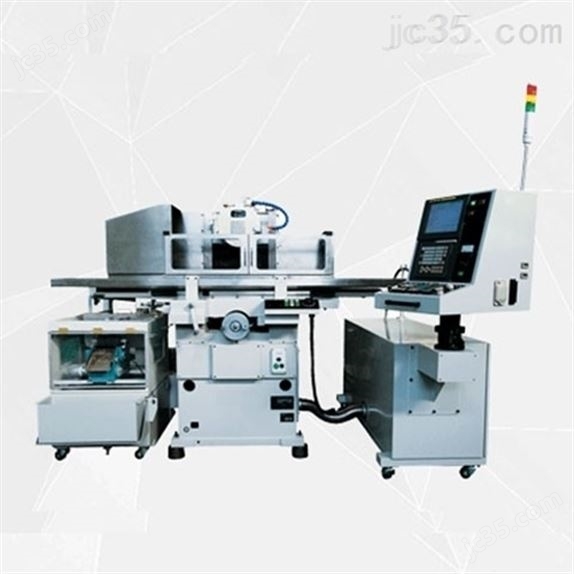
Secondly, the high rigidity structure and efficient processing efficiency accelerate the production of complex workpieces. The equipment bed adopts integral casting technology and reinforced rib design, with rigidity increased by more than 50% compared to ordinary grinding machines. It can withstand the cutting force during complex forming and grinding, avoiding machining errors caused by machine tool deformation; The spindle is equipped with a high-power motor with high torque, which can adopt a large feed rate grinding process. For stainless steel irregular workpieces with a thickness of 10mm, the processing efficiency is more than 10 times higher than traditional manual grinding; At the same time, it is equipped with an automatic switching device for grinding wheels, which can store 3-6 different profiles of grinding wheels. For workpieces with multiple forming processes, there is no need to stop and replace the grinding wheels, greatly reducing the processing cycle. It can process 30-50 irregular workpieces per day.
In terms of adaptability and practicality, the detailed design of the forming surface grinder conforms to complex machining requirements. Equipped with specialized fixtures and positioning devices for workpieces, modular fixtures can be customized for different shapes of irregular workpieces to ensure stable clamping and accurate positioning, with a repeated positioning accuracy of ± 0.005mm. Equipped with a real-time contour detection system, the contour of the workpiece forming surface is detected in real time during the processing process through laser probes or contact probes. If there is a deviation, the grinding parameters can be automatically adjusted to avoid waste production; In addition, the device operation interface supports graphical programming, and staff can import 3D models of workpieces to automatically generate grinding trajectories, reducing the difficulty of programming complex workpieces and shortening production preparation time.
From the complex cavities of automotive molds to the irregular components of aerospace, to the special surfaces of precision fixtures, the forming surface grinder breaks the limitations of traditional flat machining and provides a full scenario solution for the processing of complex irregular workpieces. Choosing a professional surface grinder is not only a choice to enhance the processing capability of complex workpieces, but also a key step to help enterprises expand product categories and enhance market competitiveness, promoting the deep development of the manufacturing industry towards "complexity and precision".