-
E-mail
zhangmy@xknc.net
-
Phone
13817072809
-
Address
1st Floor, Building 5, No. 351 Sizhuan Road, Songjiang District, Shanghai
Shanghai Shangshan Precision Machinery Co., Ltd
Brother machining center: versatile craftsman for complex parts processing
Date: 2025-09-09Read: 6
Brother machining centerAs a powerhouse in the field of processing, it plays a crucial role in the manufacturing industry with strong comprehensive processing capabilities and high flexibility. It integrates various machining methods such as turning, milling, and drilling, and through multi axis linkage, can transform complex design drawings into high-precision physical parts, widely used in industries such as mold manufacturing, medical equipment, and precision machinery.
Multi process integration is the core advantage of machining centers. Under the traditional processing mode, a complex part needs to be processed between multiple devices, and multiple clamping can easily introduce errors and consume a lot of time. The machining center can complete multiple processes in one clamping. For example, in mold manufacturing, it can mill complex cavity contours, drill and tap holes, and complete the processing of cooling water channels, reducing the number of clamping times. This not only improves processing efficiency but also ensures the positional accuracy of various parts of the parts. The service life and product quality of the mold are also improved accordingly.
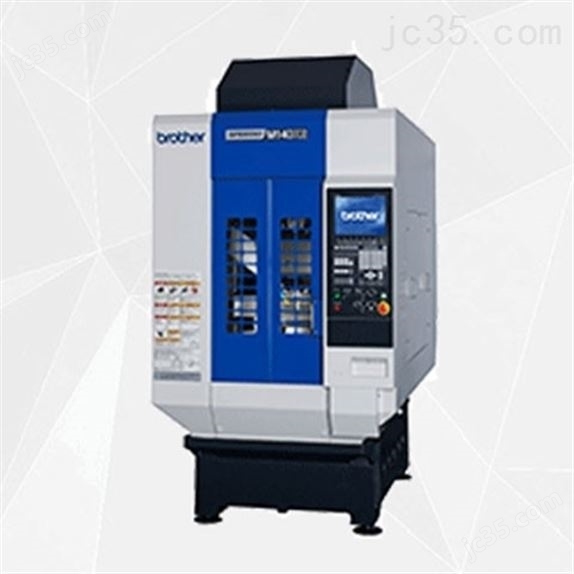
Multi axis linkage endows Brother machining center with the ability to process complex surfaces. In the artificial joint processing of medical devices, the complex surface of the joint needs to accurately fit the human skeletal structure. The machining center can precisely cut the surface shape that meets biomechanical requirements through multi axis coordinated motion, ensuring the joint's mobility and implant safety. In the machining of aircraft engine impellers, it can perform five axis linked milling on the blades, achieving high-precision blade forming and improving the power output and fuel efficiency of the engine.
The intelligence and automation level of Brother machining centers are also constantly upgrading. Some models are equipped with automatic loading and unloading devices, achieving unmanned production, reducing labor costs, and improving production continuity and stability. The intelligent monitoring system monitors the machining process in real time. Once abnormal situations such as tool wear and workpiece displacement occur, it can promptly alarm and automatically adjust, reducing the scrap rate and ensuring smooth production.