-
E-mail
450660855@qq.com
-
Phone
13805846644
-
Address
No. 20 Xingxue Road, Yuyao City, Zhejiang Province
Ningbo Hengfeng CNC Machine Tool Co., Ltd
In depth analysis of the functional characteristics of each component of the CNC gantry machining center
Date: 2025-10-23Read: 4
In the fields of heavy equipment manufacturing, aerospace structural components, large molds, and energy equipment processing, CNC gantry machining centers, with their large body and precise skills, undertake composite machining tasks such as milling, boring, drilling, and tapping of ultra large and difficult workpieces. Its iconic "door" shaped frame structure endows it with rigidity and load-bearing capacity. Only by deeply analyzing the functional characteristics of each component of the CNC gantry machining center can we appreciate the technological power behind this behemoth.
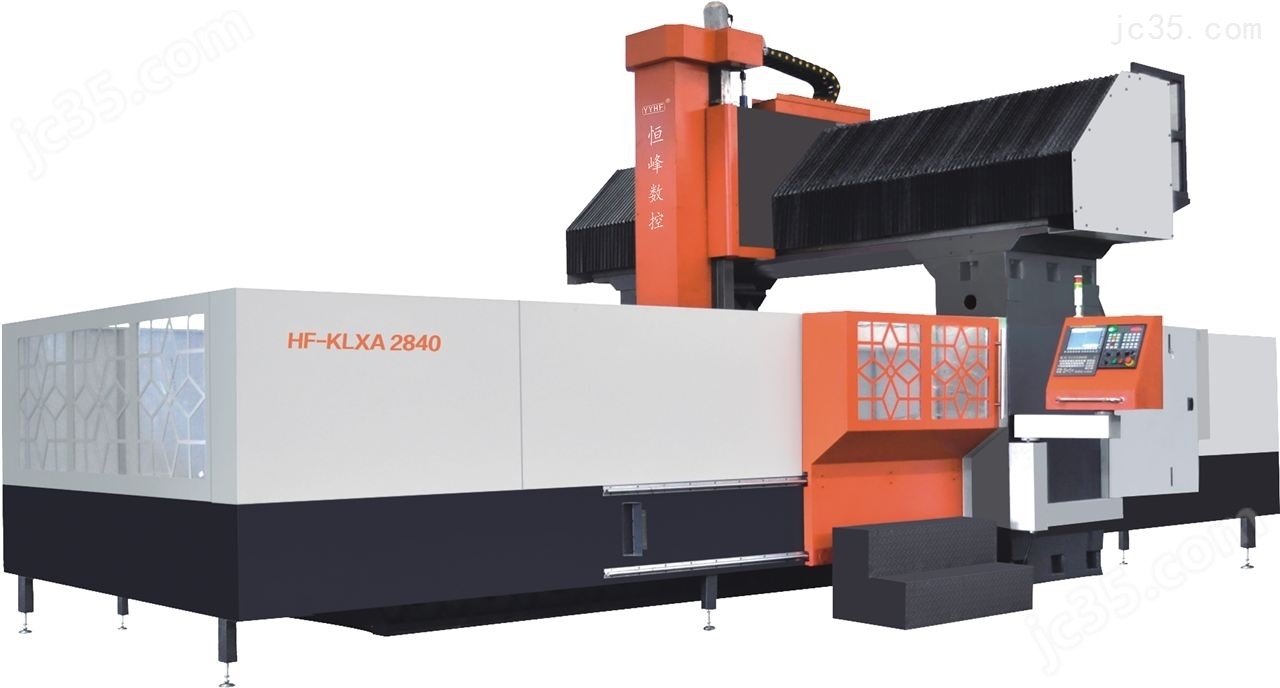
1. Longmen frame
The "door" structure composed of a base, left and right columns, and crossbeams is usually made of high-strength mineral castings or high-quality cast iron, with high static and dynamic rigidity. This design effectively disperses cutting force, resists vibration deformation, ensures machining accuracy even under large cutting amounts, and is the cornerstone of stable operation of the entire machine.
2. Spindle system
According to processing requirements, different types of spindles are equipped: high-speed electric spindles (up to 20000 rpm) are suitable for precision machining and small tool cutting; A high torque gear transmission spindle is superior to heavy cutting and rough machining. The spindle is equipped with a built-in constant temperature cooling system and high-precision bearings to ensure thermal stability and radial runout accuracy during long-term operation.
3. Three-axis motion system
The X-axis (vertical movement of the worktable), Y-axis (horizontal movement of the crossbeam), and Z-axis (vertical feed of the slider) are all driven by high-precision ball screws or gear racks, combined with linear or static pressure guides. Double drive synchronization technology is commonly used for large-span Y-axis to eliminate beam deflection, improve positioning accuracy and dynamic response.
4. Sliding pillow and accessory head
The Z-axis end is connected to a telescopic slider, increasing the processing depth. Some models are equipped with CNC swing angle heads (such as A/C axis) to achieve five axis linkage machining, easily handling complex surfaces and multi angle hole systems, greatly improving process flexibility.
5. Numerical Control System
Integrated CNC controllers (such as Siemens 840D, Heidenhain iTNC640), supporting complex programming, tool compensation, online measurement, and simulation functions. The graphical interface is easy to operate, and the powerful data processing capability ensures smooth and accurate multi axis collaborative motion.
6. Automatic Tool Change System (ATC) and Tool Storage
Equipped with a chain or bucket hat style large capacity tool magazine, fast automatic tool change (ATC) is achieved through a robotic arm, reducing non processing time. Some heavy-duty models adopt a dual tool magazine design to further enhance their continuous operation capability.