-
E-mail
450660855@qq.com
-
Phone
13805846644
-
Address
No. 20 Xingxue Road, Yuyao City, Zhejiang Province
Ningbo Hengfeng CNC Machine Tool Co., Ltd
Briefly describe the correct usage method of CNC horizontal machining center
Date: 2025-10-09Read: 4
CNC horizontal machining centers, with their high automation, precision, efficiency, and multi-faceted processing capabilities, have demonstrated their prowess in fields such as automotive, aerospace, and mold manufacturing. Its spindle is horizontally arranged and, in conjunction with a rotary worktable, can be clamped at once to complete composite processing such as milling, drilling, boring, and tapping on multiple surfaces of the workpiece, significantly improving processing accuracy and production efficiency. However, its structure is complex and the system is precise. Improper operation can easily lead to equipment damage, tool scrap, or safety accidents. Mastering the correct usage of CNC horizontal machining centers is the key to mastering this instrument.
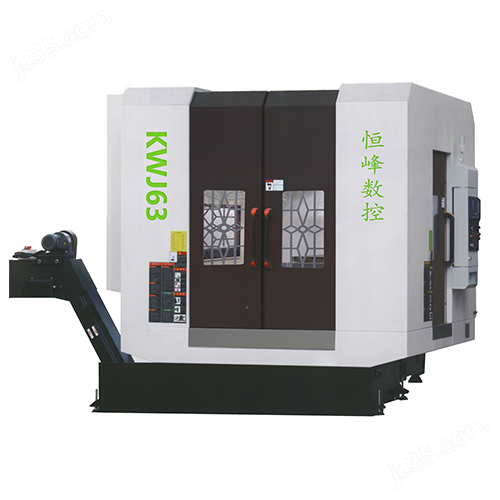
1、 Preparation before startup
Environmental inspection:
Confirm that the temperature and humidity in the workshop meet the equipment requirements (usually 15-25 ℃, humidity<70%);
Check the air source pressure (0.5-0.7MPa), stable power supply voltage, and good grounding.
Equipment status confirmation:
Check whether the lubrication of the guide rail and screw is sufficient and whether the oil level is within the normal range;
Confirm that the coolant tank level is sufficient and the filtration system is unobstructed;
Check that safety devices such as protective doors, emergency stop buttons, and light barriers are functioning properly.
Preparation of workpieces and fixtures:
Verify the processing program and process documents;
Check that the fixture is securely installed, accurately positioned, and the clamping force is moderate to avoid deformation of the workpiece.
2、 Power on and reset to zero
Power on startup:
Turn on the main power supply, machine tool power supply, and CNC system in order;
Observe for any abnormal alarms.
Mechanical zeroing:
Perform the 'back to reference point' operation to reset the X, Y, Z, and B (turntable) axes to zero;
Ensure the accuracy of the coordinate system to provide a reference for subsequent processing.
3、 Tool and workpiece clamping
Tool installation:
Use standard rivets and handles to clean the taper hole and end face;
Measure the length and diameter of the tool on the tool presetter and input them into the tool compensation table;
Confirm that the tool model, specifications, and program are consistent.
Workpiece clamping:
The workpiece should be placed steadily to avoid excessive eccentricity;
Use pressure plates, pliers, or specialized fixtures to ensure reliable clamping;
Use a dial gauge to calibrate the workpiece reference plane and ensure positioning accuracy.
4、 Program validation and trial operation
Program import:
Transfer processing programs through USB flash drives, networks, or DNC methods;
Check the program syntax and tool path for errors.
Empty running and graphic simulation:
Turn on the "empty run" mode and observe whether the motion trajectories of each axis are normal;
Use the graphic simulation function of the CNC system to check for interference or overtravel.
Trial cutting:
Adopting single-stage execution and low magnification feed, gradually verifying the machining process;
Measure the dimensions after cutting, confirm the accuracy meets the standard, and then switch to automatic machining.
5、 Automatic processing and monitoring
Parameter settings:
Set spindle speed, feed rate, and cutting depth to meet process requirements;
Turn on the coolant to ensure tool heat dissipation and chip removal.
Process monitoring:
Observe the cutting status for any abnormal vibrations, noise, or sparks;
Regularly check the wear of cutting tools and replace them in a timely manner.
Tool change and turntable action:
Ensure smooth tool changing in the tool magazine and accurate indexing of the turntable;
Avoid collisions between workpieces, cutting tools, and fixtures.
6、 Shut down
Processing completed:
Complete all processes, exit the tool, and turn off the spindle;
Clean the chips, coolant, and wipe the surface of the machine tool.
Shutdown sequence:
Turn off the CNC system → machine tool power → main power supply;
Release air pressure to prevent cylinder misoperation.